
Posting the NFPA 704 Diamond placard can be a helpful tool, but it comes with a list of to-dos. At the top of that list is using the right numerical rating and symbol to help ensure accurate information is relayed to emergency responders during critical moments.
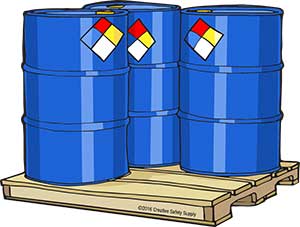
Besides rating, proper sizing and placement are crucial elements to providing immediate hazard identification and advanced responder support. In this article, you can learn how to label your NFPA 704 diamond with our custom labels, designed to develop an informed emergency strategy.
Elements of NFPA 704 Diamond
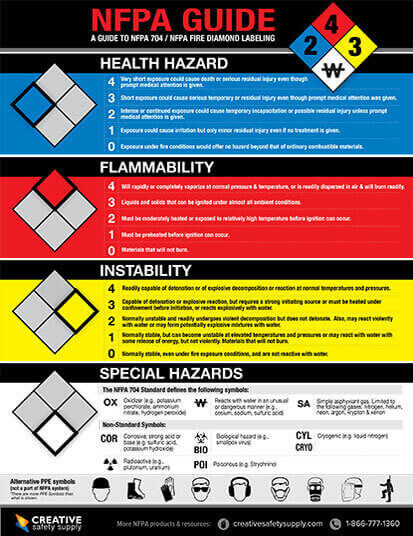
The NFPA 704 label contains an incredible amount of information in a compact and easy-to-understand format. This includes a color code, each of which reflects a specific hazard designated by a numerical rating or symbol. The following elements are:
Color Codes
The NFPA 704 label is composed of four smaller color-coded diamonds that form one large diamond shape.
Each color-coded section of blue, red, yellow, and white represents a different type of hazard. With the exception of the bottom white diamond, each will have a number corresponding to the level of danger a chemical poses.
On a scale of 0-4, zero represents no hazard at all, and four represents an extreme hazard. The hazard diamond prepares workers for potential exposure. Each number also has a specific meaning based on which diamond it is in.
Numerical Rating of Each Quadrant
Here’s a brief overview of what each numerical rating represents for each quadrant.
Left Diamond | Health Hazard | Blue
The blue diamond on the left side of the NFPA label is used to alert people to existing health hazards.
The higher the number, the more precautions someone must take when working with the chemical or dealing with an emergency. The numerical codes used in this section are broken down as follows:
0 – Chemicals in this level pose no health hazard and do not require any protection methods. Chemicals like water and others that are entirely safe under normal use can be labeled with a zero in this category.
1 – Level one for the health hazard category is for any chemical that will only cause mild irritation or injury due to exposure. In most situations, no extra personal protective equipment is needed beyond perhaps gloves.
2 – Level two is designated for chemicals that have the potential to cause temporary incapacitation or residual injury, but only if there is intense or prolonged exposure to the chemical.
3 – This level is reserved for chemicals that will cause either a temporary or moderate residual injury within a short exposure period.
4 – Level four chemicals can cause serious injury or death with even brief or limited exposure. Extreme precaution is necessary at this level. Personal protective equipment needs to be worn before working with this chemical or even the container that holds it. This is especially true during an emergency such as a chemical spill.
Top Diamond | Flammability | Red
The red diamond on the top of the NFPA label is known as the fire diamond. Chemicals that cannot burn will have a zero in this diamond, and those that are extremely flammable will have a four. Most chemicals will have a rating somewhere in between. The number breakdown for this section is as follows:
0 – Any label that has a zero in this diamond is a material that will not burn, even in typical fire conditions. The specific standards followed for this level state that this is for materials that will not burn while in the air and exposed to a temperature of 1500°F for five minutes.
1 – Any material or chemical that will burn, but only when heated significantly. These materials must have a flash point of 200°F or higher.
2 – Any material or chemical that needs to be exposed to a "relatively" high temperature before it will ignite is placed under this designated rating. Flash points between 100°F and 200°F are at this level.
3 – In category three belong the chemicals that will ignite under most ambient temperatures, have a flash point below 73°F, and have a boiling point of only 100°F.
4 – Items found in this category will readily burn and have a flash point that is below normal room temperatures (73 degrees). These are the most dangerous and include chemicals like acetylene and propane.
Right Diamond | Instability | Yellow
The yellow diamond on the right side of the NFPA label informs people about how stable the chemical is.
It must be noted that this section of the NFPA diamond label will not provide any information about what causes the chemical to be unstable. Emergency response teams must look further into the nature of the chemical to learn this, and if chemicals are unable, responders should take extreme precaution to avoid any type of reaction.
The levels for this section are:
0 – A zero signifies a very stable substance. It will not react even under conditions such as fire or immersion in water.
1 – A one signifies stability under most conditions, but when temperatures or pressures are elevated significantly, the substance may become unstable.
2 – Chemicals labeled as a two in the yellow diamond can undergo a violent chemical change when exposed to elevated pressures or temperatures. In addition, they may have serious reactions when exposed to water.
3 – A three signifies high instability properties. This chemical may explode or detonate after an ignition or when exposed to heat. This type of chemical may also have a serious reaction to water or a shock.
4 – Chemicals at this level can react or detonate even at normal pressures and temperatures. They need to always be kept in a well-regulated environment to ensure a dangerous reaction doesn’t occur.
Bottom Diamond | Special Precautions | White
The white diamond at the bottom of an NFPA label does not contain a number like the others because it does not list the severity of a particular type of hazard. Instead, this diamond contains symbols that convey special precautions or hazards that employees may be exposed to.
There are three symbols approved by the NFPA 704 system:
W – A “W” indicates a strong reaction to water. Chemicals like potassium, magnesium, rubidium, and cesium that will explode, burn, or give off dangerous gases when exposed to water. This is an especially important warning for firemen and other emergency responders not to use water on or around this chemical.
OX – The “OX” symbol indicates a violent reaction if exposed to oxygen. A strong oxidizer like ammonium nitrate, or perhaps ketone peroxides, bromates, and chromates, should be labeled with this symbol to avoid puncturing or opening a container.
SA – Used for simple asphyxiating gases, the “SA” marking warns workers of gases that reduce or displace oxygen in the area. Gases, or chemicals in liquid form that can evaporate, can cause this reaction. Nitrogen, helium, neon, and argon are the primary culprits.
There are also several "non-standard" symbols commonly used by facilities. While not officially a part of the NFPA 704 system, it is a good idea to be aware of their existence because of their widespread use. These symbols are:
COR, ACID, ALK – These symbols are used for any chemical that is corrosive, including strong acids and bases.
BIO – Any chemical that presents a biological hazard may be labeled with this symbol.
POI – All poisonous chemicals fall under this symbol.
RA or RAD – Any radioactive chemicals can be labeled with this symbol.
CRY or CRYO – Cryogenic chemicals may have this symbol listed in the white diamond.
Knowing what each symbol or rating stands for is crucial for immediate assessment. With our downloadable NFPA labeling guide, you can access essential information when needed. Each of these symbols should be legible from a significant distance, making appropriate sizing an important part of NFPA 7O4 labeling.
Sizing of the NFPA 704 Diamond
The size of your placard matters and depends heavily on the distance at which the hazard ratings should be legible. This rating should be clearly visible from 50 feet away, as recommended by the NFPA. You can use this table as a reference for NFPA-approved lettering at what distance.
| Distance (feet) | Hazard Rating Number/Symbol (inches) |
| 50 | 1 |
| 75 | 2 |
| 100 | 3 |
| 200 | 4 |
| 300 | 6 |
Location of the NFPA 704 Diamond
When considering the placement of your fire diamond, it’s important to note whether any chemical substances in the facility could cause serious injury or death. If you’re confused about where to post your Fire diamond, our in-depth article on NFPA 704 can help you make an informed decision.
Common Examples of NFPA Diamond Labeling
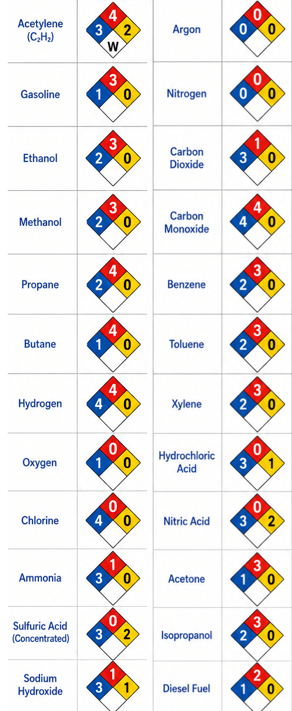
Listed below are some of the most common chemicals, annotated according to the NFPA 704.
Learn More About the NFPA 704 Diamond
If the Authority Having Jurisdiction (AHJ) in your state has determined that NFPA 704 should be adopted, learning more about this “safety diamond” can help facilitate better emergency response during critical moments. With our in-depth guide on safety labels and custom NFPA signs, you can ensure compliance with quality labels and credible information.
Additional NFPA 704 facts:
- NFPA 704, also known as a fire diamond, is a diamond-shaped sign or picture that tells people about the hazards of a chemical compound. It was designed in 1960 by the National Fire Protection Association, as a way of quickly telling firefighters and other emergency workers what kind of dangers might be nearby. Source: https://en.wikipedia.org/wiki/NFPA_704
- NFPA 704 represents a diamond with colored safety square and embedded number from 0 to 4. Zero signifies no hazard and 4 presents maximum risk. The four divisions are typically color-coded with red on top indicating flammability, blue on the left indicating level of health hazard, yellow on the right for chemical reactivity, and white containing codes for special hazards. Source: https://batteryuniversity.com/article/bu-704d-nfpa-704-rating
- NFPA 704 is a standard maintained by the U.S.-based National Fire Protection Association. It is an internationally accepted safety standard, and is crucial while transporting chemicals. Source: https://en.wikipedia.org/wiki/NFPA_704
- The development of NFPA 704 is credited to the Charlotte Fire Department after a fire at the Charlotte Chemical Company in 1959 led to severe injuries to many of the firefighters. Upon arrival, the fire crew found a fire burning inside a vat that firefighters assumed to be burning kerosene. Source: https://en.wikipedia.org/wiki/NFPA_704
- NFPA 704 is not a regulation, but rather a voluntary consensus standard that can be adopted by local authorities. It is not intended for use by the general public, and should not be confused with the hazard symbols used in consumer product labeling. Source: https://www.nfpa.org/codes-and-standards/7/0/4/nfpa-704
Similar Articles
- NFPA 704
- NFPA 99: Understanding the Health Care Facilities Code
- Waste Water Treatment Labeling
- Understanding Canadian Pipe Marking Standards (CAN/CGSB-24.3-12) and Hazard Symbols
- Labeling Practices for Power Generation Facilities
- The Definitive Guide to Globally Harmonized System (GHS) Labeling
- Hazardous Materials Identification System (HMIS Labels)
- NFPA 855: The Installation of Stationary Energy Storage Systems
- Your Guide to Pipe Labeling Standards
- Anhydrous Ammonia – Safety & Labeling