
- What Is Organizational Development?
- The Organizational Development Process Cycle
- Essential Objectives Of The Organizational Development Model
- Models Of Organizational Development
- Benefits Associated with Organizational Development
- Common Challenges From Implementing Developmental Change
- What Is the Difference Between OD and Human Resources (HR)?
- Design An Effective Strategy With Creative Safety Supply
In the fast-paced and ever-evolving landscape of the business world, growth, development, and change are paramount. Making it essential for businesses to comply with e-commerce trends like social presence, digital marketing, and providing convenient online customer service to drive productivity and results. This is the essence of organizational development.
However, this approach isn’t as simple as integrating a new system into your organization or transitioning to an e-commerce design. Every step of the process is structured, from identifying problems and overcoming barriers to implementing the new system seamlessly. If you’re unfamiliar with this term, this article will help you get up to speed on how to help your business grow.
What Is Organizational Development?
Organizational development is a structured, systematic process that aims to help companies adapt to changing market conditions, drive productivity, and enhance engagement to stay relevant and expand their market reach.
There are key stages in the organizational development process:
Diagnosis and Assessment:
The initial stages involve assessing the organization's overall structure. Here, managers must identify problems, strengths, weaknesses, and areas for improvement through Gemba walks, surveys, and employee reviews.
Planning And Intervention Design:
After the assessment, appropriate strategies are designed to address the identified issues. These can include team-building activities to enhance synchronization, communication training to improve workplace productivity, or leadership development programs to address low employee morale.
Implementation:
The planned interventions are then put into action, often in the form of employee meetings, to ensure active participation and keep everyone in the loop about the current changes being made.
Reviews and Success:
Implementation does not drive change immediately; it’s essential to collect employee feedback, regularly assess the effectiveness of the planned changes, and make adjustments if necessary. This flexible approach is designed to ensure the desired outcomes are being achieved.
The Organizational Development Process Cycle
Organizational development begins when a problem is identified. This system can be used to make improvements on just about any situation or problem that a business can face. It is a broad set of steps that are easily understood and provide companies with the ability to make changes quickly to solve issues. Once the changes are made, they can be evaluated to see if the problem was resolved, and if not, it will continue through the development process.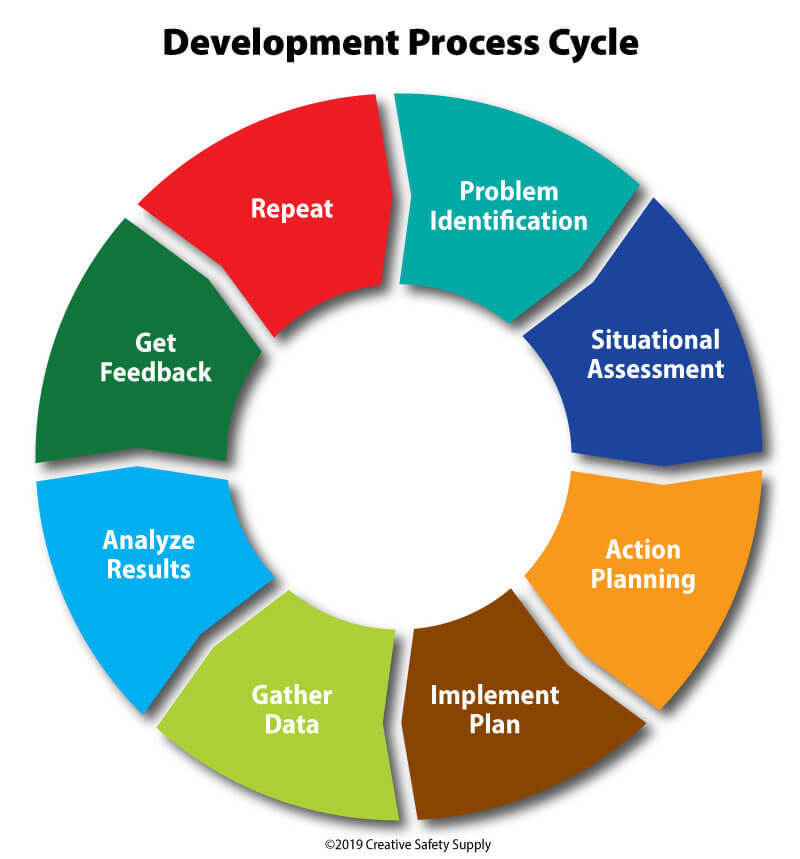
This process runs through the following steps:
Problem Identification: Organizational change begins by identifying a missing element that hinders productive results. It may be in the form of poor team management or insufficient resources that impact the overall structure. A problem can be identified in a wide range of ways, including reports from employees, data gathering, etc.
Situational Assessment: Making a formal assessment of the situation is the next step. This can be done by reviewing documentation, holding focus groups, interviewing, or surveying. Gathering all the facts related to the problem at hand is important for developing an effective solution.
Action Planning: Designing an effective strategy to address the identified problem is the next step of the planning process. This should be done by incorporating input from all impacted parties so that a solution that addresses the specific problem at hand can be found. In many cases, this will be the longest step in the process.
Implement Plan: Take the plan made in the previous step and put it into action. Depending on the complexities of the change, this may include training and other steps needed to ensure the action plan is put in place correctly.
Gather Data: As soon as the change is put in place, it is time to start gathering data. This should be done with a focus on identifying whether the changes made are having a positive impact on the problem at hand.
Analyze Results: Look at the gathered data to see if the plan has improved the problem, eliminated the problem, did nothing to the problem, or made the problem worse. In addition, watching to see if the changes had any secondary, negative impacts on other issues is also done here.
Get Feedback: Gathering feedback from all impacted parties must happen next. If the problem has been eliminated but increases the risk of injury for employees, for example, then it wasn't a good solution.
Repeat: If necessary, the process will be repeated. If the changes made have some positive impact, then the process will begin with the current system in place. If they didn't, it may be beneficial to go back to the original way things were done to reevaluate.
By following these steps, a company can make significant improvements in a very orderly fashion. They will also be able to track the changes that are made to have real data when it comes to finding solutions to problems.
Having access to this data not only helps to ensure that problems are solved objectively, but it can also help find solutions to other issues more quickly. If another department is facing a similar problem, the data and strategies used can be applied. This can help to cut back on the length of time it takes to address many types of issues.
Essential Objectives Of The Organizational Development Model
Just like with any workplace improvement strategy, there are a set of objectives that the company wishes to achieve. However, they are also usually modified a small amount to fit the company’s needs as well.
The following is a basic list of objectives for participating, and succeeding, in implementing organizational development:
- Improve inter-personal trust among employees.
- Increase satisfaction and commitment.
- Confront problems immediately instead of ignoring them.
- Manage conflict effectively.
- Improve cooperation and collaboration.
- Increase the rate of problem-solving.
- Consistently establish processes that assist in improving the continuing operation of an organization.
Management strategies like OD cannot be successful without a clear vision in mind. Do the work involved in understanding the values, to then be able to meet these objectives and exceed companywide goals.
Models Of Organizational Development
Building an entirely new structure for your organization can be overwhelming, but some organizational models can help build an efficient framework that aligns with your business goals.
Here’s a breakdown of common organizational development models:
Lewin’s Three-Step Model
The aim of this model is to eliminate the fear behind change and its adverse side effects, which in hindsight, could be a large contribution to the development of the establishment. The three stages of the Kurt Lewis model are as follows:
Unfreeze:
In the initial stage, an altering event is to be observed which distracts the management flow of the organization. Falling profits and customer or employee dissatisfaction are all common symptoms that highlight the possibility of changing dynamics within the establishment. The role of the organization in this stage is to develop awareness on answering the queries that resist or question the need for change.
Change (or Transition):
Once the organization has effectively communicated the need for change, the next stage ensues: the change stage. This stage comprises implementing the necessary improvements to eliminate the barriers faced in the previous stage. Two integral aspects of this stage define the seamless integration of change, open communication, and strong leadership skills. This stage highlights the incorporation of change towards improving current procedures.
Freeze (or Refreeze):
The final stage solidifies the reality of the change, incorporating it into the organization’s system and policies. Freeze is considered to be a crucial stage that determines the settlement of the changing dynamics. The possibility of reverting back to outdated previous habits is a likelihood which should be supervised by the organization.
Action Research
Besides the three-step model, Lewin also created the action research model, which includes three steps:
Step 1: Research on Existing Problems and Design Solutions
The initial phase involves gathering data to identify problems and includes hiring an outside consultant or specialist to gather precise information. The main purpose of this phase is to implement a result-focused solution.
Step 2: Action Phase
This phase is categorized by change, where the designed strategy is implemented to drive change and observe results that align with the purpose of the implementation. Intentional communication and employee cooperation are the driving forces behind the success of this stage.
Step 3: Input and Results Phase
The final phase involves data collection after the implementation of the strategy. This step is crucial to determine whether the change was a success or needs further revision.
Kotter's 8-Step Change Model
Unlike other organizational models, the Kotters 8-step change model follows a structure of urgency to implement changes and ensure lasting results. Here’s a breakdown of each step:
Step 1: Create A Sense of Urgency
Alert employees about the need for change by bringing current imperfect systems to light.
Step 2: Establish A Coalition
When a change directly impacts a group of people, it’s better to work as a team for effective communication and efficient results.
Step 3: Develop A Strategic Vision and Strategy
The goal should be clear from the get-go to ensure each step of the process is aligned with the guidelines in mind.
Step 4: Communicate The Vision
What you aim to achieve has to be clearly communicated to the relevant stakeholders and involved employees. Involved employees have to understand the “why” and “how” of the change.
Step 5: Empower Broad-Based Action
Work to simplify the process for everyone. This includes eliminating obstacles such as communication gaps, boosting employee morale, and encouraging employees' participation during the process. This builds trust, which ultimately drives the success of the change.
Step 6: Plan Short-Term Wins
Instead of implementing a significant change, such as restructuring the basics of a procedure. Plan and start off with small changes that guarantee success, which creates value in front of the organization’s personnel. Observing such wins can help increase the need for change.
Step 7: Consolidate Gains and Initiate More Change
After resolving apparent areas of improvement, target further opportunities for improvement that guarantee boosted results. This strategy can help eventually lead to a road of continuous improvement, which is the driving force behind organizational excellence.
Step 8: Ensure The New Approach Is Finalized
Implementing changes is not the only step involved in organizational development; a significant step is to implement a change that naturally becomes a major part of everyday procedures.
Benefits Associated with Organizational Development
Employers that choose to implement organizational development strategies are actively choosing to improve productivity and efficiency in the workplace. In fact, OD exists to specifically ensure a company can quickly adapt to ever-changing markets and do so in a way that is positive for the organization as well as their customers.
But what exactly comes out of a more efficient and productive workplace? Let’s explore.
- The need for a continuous improvement culture is established. The organizational development process is very cyclical in nature. That said, companies that embrace change like those who use OD, are more willing to find more improvements whether that be relating to safety, a manufacturing procedure, or exploring other Lean manufacturing tools to help improve specific aspects of a workplace.
- There is an increased level of communication. The only way for an organization to improve on its business model is to establish healthy communication between other employees on the same level as well as up the leadership ladder. Communication can include feedback from customers, other employees, and management, as well as communication in the form of different departments collaborating.
- Employees experience a chance to grow their skills. By embracing change and improving communications between all members of a facility, employees will experience a level of growth that can help them feel more fulfilled and valued at their workplace.
- Products and services become more valuable. We are moving right up the ladder here. All the previous steps add to creating a workplace that is full of innovative people actively seeking improvements that, in the end, help improve the company’s main objective, whether that be providing something such as a catering service or a product like running shoes.
- More value equals better profit margins. Improvement kickstarts communication, which helps with innovation, and therefore creates a product that companies can lead the market with. A company that makes changes for the better will be able to see an increase in profits over a long-term period.
Common Challenges From Implementing Developmental Change
Making changes within a company is always going to be difficult, especially if employees and management are comfortable with where they are. That said, people are more likely to accept smaller changes over a shorter period than large changes all at once.
Let’s go over some of the most difficult challenges that organizations face when implementing OD:
- There may be a lack of leadership presence to enact change.
- There may be conflicting goals due to a lack of communication.
- Altering the mission or values of the company may result from some resistance.
- Unrealistic goals can contribute to employee burnout.
- Change may not occur because people are fearful of what will happen next. This is a prevalent problem in situations where changing a process was tried in the past and resulted in failure.
- Members of the organization may not understand why the changes were made. This can result in employees distrusting the new process and the people who made those choices.
Change is hard! But with the right procedures, anything is possible.
What Is the Difference Between OD and Human Resources (HR)?
Organizational development can be commonly mistaken as Human Resource Initiatives and vice versa. The two concepts are exceptionally vital to the growth of the company, however there are dissimilarities between the two. Organizational development is designed to assess the existing foundation, practices, and policies and insert changes and tweak them to pave the way for the evolution of the organization. Human Resources, on the other hand, is strictly associated with concerns pertaining to employees and handling tasks such as recruitment and payroll.
However, the two concepts coincide for the development of the organization as the OD process assists human resources to make considerable changes to an organization. This is established by aligning the modified and existing organizational culture and integrating them into employee management.
Speaking of humanistic values, there are six that OD uses:
- Workers must be treated as people rather than resources to create a productive process.
Opportunities must be provided for each organization member and the organization itself to reach its full potential. - Seeking improvement must always be happening to reach the organization’s goals.
- Create an environment that produces work that is both exciting and challenging.
- Provide workers with opportunities that influence the ways they relate to tasks, the business, and the environment around them.
- Realizing that every worker has a unique set of needs that are all important for their lives and how they work.
These values are essential to know if your company is looking to make the change. Deeply understanding the concept can help you be more successful in your organizational development goals.
Design An Effective Strategy With Creative Safety Supply
One common issue many companies have when they try to make improvements to their process is that while it works for a time, people often fall back into old habits. For the organizational development process to be effective, it is necessary to take steps to prevent this from happening. To help you navigate through these changes, Creative Safety Supply provides a range of guides and products, like safety signs and additional visual communication tools, to help drive change and growth to achieve organizational excellence.
Similar Articles
- What is a Kaizen Event? [Planning and Execution]
- 5 Lean Principles for Process Improvement
- Continuous Improvement (A Kaizen Model)
- 8D for Problem Solving
- What is Process Mapping? [Definition, Examples & Tools]
- Lean Software Development
- Process Cycle Efficiency (PCE)
- Hoshin Kanri
- What is Jishuken?
- Quality Control in Manufacturing