
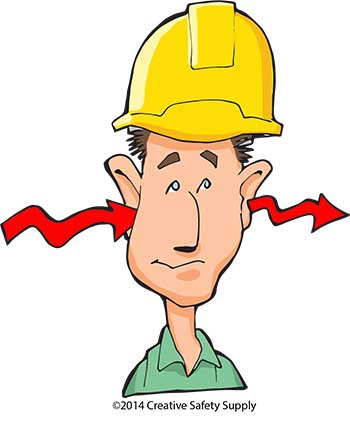
Hearing loss is a major public health concern in workplaces, being the third most common chronic condition in the USA. A large portion of the workforce, estimated at 22 million employed US citizens, experiences hazardous noise exposure annually. To address this issue, the Occupational Safety and Health Administration (OSHA) has established regulations to protect workers from noise-induced hearing loss, emphasizing the importance of employer compliance and employee safety.
Before we dive into hearing protection requirements, it’s important to know OSHA’s guidelines for safe noise exposure limits in the workplace, based on the intensity and duration of the noise.
OSHA’s Noise Exposure Limits
Hearing damage from noise exposure is based on how long the exposure lasts and how loud the noise actually is. OSHA has identified how long someone can be exposed to different levels of sound without hearing protection before it becomes unsafe.
However, while these are the limits stated by OSHA, most facilities will want to provide their employees with proper hearing protection at levels and durations significantly lower than those in this list just because it’s better to be safe than sorry. OSHA’s exposure limits include:
- 90 dB - Requires hearing protection if an employee is exposed for 8 or more hours.
- 92dB - Requires hearing protection if an employee is exposed for 6 or more hours.
- 95dB - Requires hearing protection if an employee is exposed for 4 or more hours.
- 97dB - Requires hearing protection if an employee is exposed for 3 or more hours.
- 100dB - Requires hearing protection if an employee is exposed for 2 or more hours.
- 102dB - Requires hearing protection if an employee is exposed for 1.5 or more hours.
- 105dB - Requires hearing protection if an employee is exposed for 1 or more hours.
- 110dB - Requires hearing protection if an employee is exposed for 30 minutes.
- 115dB - Noise at this volume is only safe for up to 15 minutes without protection.
Anything above 115 dB requires hearing protection, even if employees are only going to be exposed to it for a brief time. Having earplugs or other types of hearing protection available at the entrance to an area that has loud noises is an effective way to remind employees of the risk and to take proper precautions.
OSHA's Standards for Hearing Protection
OSHA requires employers to prioritize engineering and administrative controls to reduce workplace noise levels when employees are exposed to sound exceeding 85 decibels (dB). Let’s look at some engineering and administrative controls for limiting noise exposure in workplaces.
Engineering Controls:
- Noise Absorbing Panels - Installing these throughout the facility can dramatically reduce overall noise levels.
- Mufflers on Machines - Machines or vehicles that have gas engines can be very loud. Having a muffler installed can reduce OHL risk.
- Modernizing Machines - In many cases, newer machines run much quieter than older ones. Consider replacing machines or updating them to reduce noise.
- Containment - Moving particularly loud equipment into a soundproof room can help reduce noise in the rest of the facility. In many cases, these machines can even be operated by someone outside of the room.
Administrative Controls:
- Limiting the time an employee is exposed to noisy equipment
- Using noisy equipment when less people are around
- Providing rooms that are noise free to give employees a break
- Ensuring employees are well away from noisy equipment if they are not using it
If engineering and administrative controls are not sufficient to reduce noise exposure to acceptable levels, OSHA requires a hearing conservation program. Let’s look at what this program is.
What is the OSHA Hearing Conservation Program?
A Hearing Conservation Program (HCP) is a structured set of measures designed to protect workers from noise-induced hearing loss. It aims to prevent initial hearing damage, preserve existing hearing, and provide workers with the knowledge and tools, like hearing protection devices, to safeguard themselves from hazardous noise levels. The conservation program includes:
- Monitoring noise levels
- Audiometric testing for individuals
- Hearing protection
- Training
- Recordkeeping requirements
Let’s look at each component of OSHA’s hearing conservation program in detail.
Noise Monitoring Requirements
Employers must measure noise levels in the workplace to identify areas where employees are exposed to hazardous noise. This involves assessing noise levels from all sources: continuous, intermittent, and impulsive within a typical work situation.
Audiometric Testing Requirements
Regular hearing tests or audiograms are crucial for monitoring employee hearing and detecting early signs of hearing loss. Employers must provide baseline and annual audiograms, as well as follow-up procedures, at no cost to employees. These tests help identify shifts in hearing and determine if further interventions are needed.
Hearing Protection Requirements
When noise levels exceed permissible limits, employers must provide suitable hearing protection devices (HPDs) to employees. This includes ensuring access to a variety of HPDs, such as earmuffs and earplugs, and providing training on their proper selection, fit, and use.
Earmuffs
Earmuffs are designed to fit over or around the head and then cover the entire ear rather than just going into the ear canal. A properly fitting pair of earmuffs can provide a tremendous amount of protection since they stop the sound from entering the ear at all.
Some types of highly advanced earmuffs are actually built with a microphone on the outside and small speakers on the inside. These earmuffs can "listen" to the environment and replay sounds at a safe volume to the person wearing them, eliminating much of the noise during that process. This makes it possible for people to talk freely in loud environments, without being at risk of hearing loss.
Earplugs
Earplugs are one of the oldest forms of hearing protection, but they are still very effective. Earplugs are sufficient for environments with low levels of dB where hearing protection is required.
This type of hearing protection is extremely inexpensive and is disposable in most cases. Employers can put out large containers of them for the employees to wear when entering loud environments, and then employees can discard them when leaving. This is one of the easiest and most affordable ways to remain in compliance with OSHA’s hearing protection requirements.
Employee Training Requirements
Employees must receive thorough training on the hazards of noise exposure, the proper use and maintenance of hearing protection, and the importance of audiometric testing. Training should be conducted annually and include information on the purpose and procedures of audiometric testing.
Recordkeeping Requirements
Accurate records of noise exposure measurements and audiometric test results are essential for tracking employee exposure and evaluating the effectiveness of the HCP. Employers must maintain these records for specific durations. For example, OSHA regulations mandate that employers keep noise exposure measurements for at least two years, while audiometric test records must be retained for the duration of an employee's employment.
By implementing a comprehensive hearing conservation program, employers can effectively manage noise exposure and ensure compliance with OSHA hearing protection requirements, protecting employees' hearing and promoting a safer work environment.
Similar Articles
- ANSI S3.19 – Noise Reduction
- OSHA Respiratory Protection Standard (29 CFR 1910.134)
- What is HAZCOM? (Hazard Communication Definition + OSHA Standards)
- Fall Protection in the Workplace: OSHA’s Guidelines
- OSHA’s Guidelines to Protecting Employees from Coronavirus
- NFPA 25: Standards for Fire Protection Systems
- Understanding OSHA/ANSI First Aid Kit Requirements
- OSHA Construction Safety
- OSHA Safety Sign Requirements [1910.145]
- Arc Flash and Electrical Safety