
The NFPA 13 is the standardized framework for the design and installation of automatic fire sprinkler systems that work as life-saving safety networks to detect and suppress fires in their initial stages.
Adhering to this standard can help organizations develop a life-saving system that works to protect both property and civilians. This article covers how NFPA 13 regulates proper fire sprinkler installation, highlighting key aspects like standard requirements, routine updates, and more.
What is Covered Under NFPA 13?
NFPA 13 is an industry-recognized guideline that covers how automatic fire sprinkler systems must be designed, installed, and tested to ensure maximum reliability and life safety during a fire event. It includes specifications on using different types of sprinkler systems, pipe sizes, valves, fittings, and hangers, along with guidance on how to avoid structural obstructions.
Key Updates of NFPA 13 (2025) Latest Edition
NFPA 13 undergoes a three-year revision cycle, during which new updates are implemented based on data gathered in the field and technological advancements. Here are some key updates found in the the NFPA 13 2025 edition:
- Corrosion-Control: The standard offers an accepted method to control corrosion through Vapor Corrosion Inhibitors, which are defined in Section 3.3.242 as “A chemical compound that emits rust-inhibiting vapor to protect ferrous and nonferrous metals against corrosion in air-filled dry pipe or preaction sprinkler systems.”
- Vacuum Dry Systems: Also known as negative pressure systems, the standard offers design and installation guidelines that cover these critical systems.
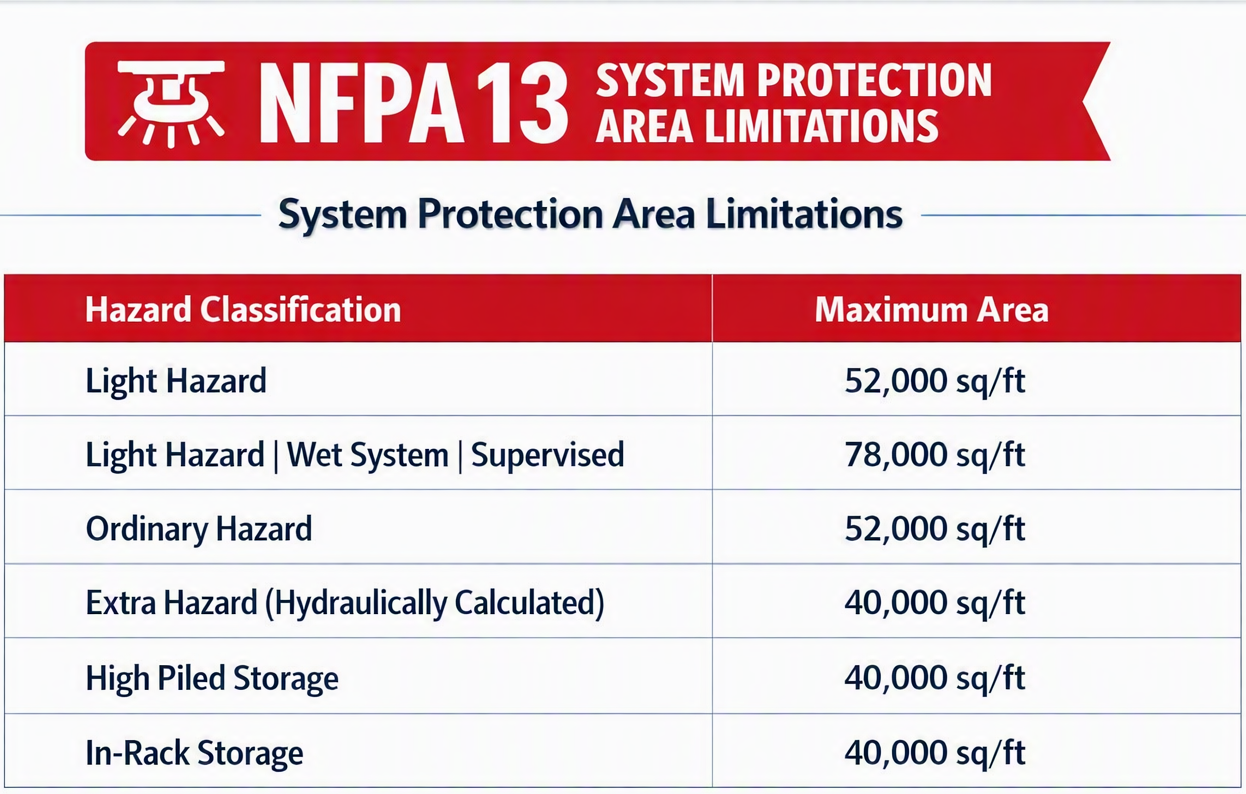
- Area-defined limits: The NFPA 13 offers a revised version of area-defined system limitations based on their specific types of hazard classifications. For instance, the area limitation for light hazard wet piping systems that are electrically supervised has been upgraded from 52,000 square feet to 78,000 square feet— a large gap, jumping 50%. Here’s an updated table of all the sprinkler system area limitations:

- Obstruction Rules: Offers additional recommendations on the placement of sprinklers under obstructions, also known as supplemental sprinklers, which are:
- Must be a quick response or have a fast response element.
- Permitted to have different K-factor, orientation, and coverage than the ceiling sprinklers under certain conditions.
- Required to have a water shield (or otherwise shielded) where installed:
- Under non-flat obstructions
- Under non-solid obstructions
- Beyond the outer edge of the obstruction
- Under open grating
- C-Factor Adjustments: Requires the C-factor for dry systems and preaction systems with vapor corrosion inhibitors (VCI), and for vacuum systems to be changed from C-100 to C-120.
- Elevator Hoistways: Do not need to be equipped with sprinklers; the same applies to pits.
Requirements of NFPA 13 Standard
The NFPA 13 dictates the comprehensive design and initial acceptance testing following installation of multi-occupancy fire sprinkler systems. Before we take a look at the specifications of NFPA 13, it’s important to understand the types of sprinkler systems covered under this standard:
Permitted Sprinkler System Types
NFPA 13 specifies the use of different sprinkler systems that are a better fit for certain types of environments and the specific hazards present within those spaces:
- Wet pipe sprinkler systems: Best for heated buildings, as they contain pressurized water for immediate release, have fewer moving parts, and require little maintenance.
- Dry pipe sprinkler systems: Filled with pressurized air or nitrogen, dry pipe sprinkler systems hold the main water valve shut until activation. Such systems are best suited for unheated or freezing environments where standard piping systems would typically freeze.
- Pre-action sprinkler systems: Use a combination of air and water to suppress fires with the help of a two-step fire detection system. This type of system consists of smoke or heat detectors that activate the commercial fire alarm system, which offers a high level of reliability and protection against false alarms.
- Deluge systems: Consist of a specialized fire suppression system where sprinklers are permanently open, which release a flood of water to address fires in areas with hazardous chemicals present or high-hazard industrial areas.
- Foam-water systems: Discharge a combination of foam and water that creates a blanketing effect to extinguish a rapidly spreading fire, commonly stemming from highly combustible or flammable materials.
After analyzing the types of fire sprinkler systems best suited for your environment, you can move on to the specifications of NFPA 13.
Fire Sprinkler Plan Submittal Requirements
NFPA 13 specifies strict specifications for providing a sprinkler installation plan to the Authority Having Jurisdiction (AHJ), which can be your local fire department, for review. Here are some aspects of what your fire sprinkler plan should include:
- One set of electronic copies of your sprinkler plan. (.pdf format only)
- One set of hydraulic calculations for each design area.
- Water flow data (within 12 months) from NCSD Utilities, NFD, or other approved water supply source.
- A set of manufacturers' material information sheets on different components, like fire sprinkler heads, piping, bell and horn/strobe device, flow switch, and hangars.
Occupancy Hazard Classification
The NFPA 13 classifies buildings based on their capacity to contain an expected fire (heat release). Some of the main factors leading to increased fire growth and spread, and therefore higher hazard classifications include:
- Stockpile height, defined as the vertical distance from the floor to the highest stored commodities and materials
- Flammable liquids
- Combustible liquids
Taking such factors into consideration, the revised edition covers three occupancy hazard classifications:
- Light hazard
- Ordinary hazard, divided into 2 sub-groups
- Ordinary hazard group 1 (OH1)
- Ordinary hazard group 2 (OH2)
- Extra Hazard divided into 2 sub-groups
- Extra hazard group 1 (EH1)
- Extra Hazard group 2 (EH2)
Knowing the classification of your building as per the NFPA 13 standards can help facilitate the design, structure, and specific engineering requirements of your fire sprinkler system. Next, we'll review a bit about each classification.
Light Hazard
Light hazard occupancies possess the least fire severity due to the low quantity and/or combustibility of contents. Common examples include churches, residential buildings, and hospitals where relatively low rates of heat release are expected. Such occupancies have no processing machinery, manufacturing areas, or storage operations, where furniture is more or less permanently arranged.
NFPA 13 defines "light hazard occupancies" as "Spaces with low quantity and combustibility of contents" and requires them to be protected with light hazard occupancy criteria in this standard.
Ordinary Hazard
Occupancies classified under ordinary hazard can fit into two groups:
Ordinary Hazard Group 1 (OH1) Occupancies
NFPA 13 classifies (OH1) Occupancies that pose a moderate level of fire severity due to low combustibility. These structures should also have an 8-ft (2.4 m) height limitation for stockpiles. Common examples include automobile parking and showrooms, bakeries, beverage manufacturing, etc., where a moderate rate of heat release is expected.
Ordinary Hazard Group 2 (OH2) Occupancies
Occupancies classified under “Ordinary Hazard Group 2” have a moderate level of fire severity, which is greater than light hazard and ordinary hazard group one. Occupancies classified under this group should meet the following criteria:
- Spaces with a moderate to high quantity and combustibility of contents.
- Stockpiles of contents with moderate rates of heat release that do not exceed 12 ft (3.7m). OR
- Stockpiles of contents with high rates of heat release that do not exceed 8 ft (2.4m).
Per NFPA 13, ordinary hazard group 2 (OH2) includes occupancies having uses and conditions similar to the following:
- Cereal mills
- Chemical plants
- Confectionary plants
- Distilleries
- Dry cleaners
Extra Hazard (EH)
Occupancies classified under extra hazard can fit into two groups:
Extra Hazard Group 1 Occupancies (EH1)
Spaces under this group are classified near the top level of fire sensitivity, as they possess the following qualities:
- The quantity and level of combustibility of the contents are very high
- Dust, lint, and other materials are also present
Such elements contribute to rapidly developing fires with high rates of heat release but with little to no presence of combustible or flammable liquids. Occupancies under this category can be:
- Aircraft hangers
- Combustible hydraulic fluid use areas
- Saw mills
- Upholstering with plastic foams
Extra Hazard Group 2 Occupancies (EH2)
Spaces under this standard are categorized based on the following qualities:
- With moderate to substantial amounts of flammable and combustible materials present
- Where shielding of the combustible is required
- High quantity and combustibility of the materials of the contents are present
Common examples of the spaces classified under the group should have similar uses or processes as:
- Asphalt saturating
- Flammable liquids spraying
- Solvent cleaning
- Varnish and paint dipping
Design and Installation Specifications
To ensure compliance with NFPA 13, meeting NFPA’s design and installation specifications for different components is crucial. Here’s a look at some key prerequisites that are included, but not limited to:
- Fire sprinklers should not be placed under fire or smoke detectors.
- Sprinklers must be at least 6ft apart to prevent cold soldering (the premature cooling/activation of adjacent heads).
- Light fixtures or other components should not obstruct the dispersal path of all sprinklers and should be planned appropriately.
- For all head types, the maximum distance between walls and sprinkler heads is half the distance permitted between two sprinkler heads.
- Specifications for hangars, risers, piping, and controls should be aligned with the installation requirements of NFPA 13.
- The distance from the sprinkler to the wall is measured as perpendicular to the wall.
Initial Acceptance Testing Requirements
NFPA 13 dictates rigorous testing requirements that help establish the reliability of fire suppression sprinkler systems. Here is a list of common tests required by NFPA 13:
- Hydrostatic Pressure Test: A type of non-destructive testing method, where sprinkler piping systems are emptied and then filled with pressurized liquid beyond their normal capacity to identify leaks or structural issues. The pound force per square inch (psi) varies for each type of system, such as:
- Standard systems should be tested at 200 psi consecutively for 2 hours.
- High-pressure systems must be tested 50 psi above their average working pressure.
- Dry/Double Interlock systems should undergo a 200 psi average water pressure test, along with a 24-hour air pressure test at 40 psi.
- Flushing testing specifications: All underground and overhead systems piping must be thoroughly flushed with water to help clear away dirt, debris, or any obstructive components.
- Main drain tests: Static and residual water supply are recorded and compared with original design data to evaluate average pressure and check for defects. If the flow pressure drops by 10% or more, it usually indicates a major blockage or an obstructed pipe, which demands a full in-depth inspection.
- Alarm functionality test: Includes all types of alarms and devices that monitor or trigger the automatic sprinkler system for water flow or impairment. This includes motor gongs, valve tampers, etc.
Hydraulic Calculation
NFPA 13 dictates that hydraulic calculations are a fundamental and critical aspect of ensuring the integrity of sprinkler systems. They help establish the integrity of water sprinkler systems and whether they can provide sufficient flow or pressure to successfully extinguish a fire.
Difference Between NFPA 13 & Other Standards
NFPA 13 is a comprehensive benchmark used as a guideline for the design and installation of fire-suppression water sprinkler systems. It acts as a baseline for all building types, including high-rise apartments, commercial and industrial buildings, etc. Beyond NFPA 13, the National Fire Protection Association offers interrelated standards, such as:
- NFPA 13D: Standard for the Installation of Sprinkler Systems in One- and Two-Family Dwellings and Manufactured Homes was designed to offer a standardized system to create cost-effective sprinkler systems in residential occupancies. Ideally located in one/two family dwellings, NFPA 13D prevents the first 10 minutes of the flashover period during a fire, ultimately creating a safety plan to help occupants evacuate safely.
- NFPA 13R: Standard for the Installation of Sprinkler Systems in Low-Rise Residential Occupancies was designed to promote water sprinkler systems in buildings (up to 4 stories high), such as multi-family homes and duplexes. Compared to NFPA 13D, this standard imposes stricter requirements given the high risk to family life safety.
Here’s a visual breakdown of the differences between NFPA 13, NFPA 13R, and NFPA 13D via a table:
| Standard | NFPA 13 | NFPA 13D | NFPA 13R |
|---|---|---|---|
| Objective | life safety & property protection | life safety | life safety |
| Fully Sprinklered | Yes | No | No |
| Coverage Requirement | All Areas | Doesn’t include closets, attics, garages, small bathrooms | Allows sprinkler omissions in smaller closets, bathrooms, and attics |
| Water Supply Demand | 30+ min | 10-30 min | 30 min |
| Hydraulic Calculations | Calculates multiple operating sprinklers | Considers up to 2 operational working sprinklers | Evaluates about 4 of the most demanding sprinklers |
Benefits of NFPA 13 Compliance
Adhering to NFPA 13 guarantees comprehensive, reliable fire protection through water-based sprinkler systems that are hydraulically optimized. The primary benefits of NFPA 13 implementation are life-safety, standard compliance, liability protection, and peace of mind.
- Property protection: Compliance with NFPA 13 ensures comprehensive sprinkler systems to protect against fires by limiting flashover and minimizing structural damage. A system like this can help suppress fires from escalating until the local fire department can fully extinguish them.
- Insurance support: Buildings equipped with NFPA 13 offer ordinance and law coverage, providing discounted premium coverage without compromising construction.
- Fire Protection: Following NFPA 13 offers a high degree of property and life protection thanks to its comprehensive fire suppression system. With little to no areas left unequipped with sprinklers, buildings compliant with NFPA 13 can prevent fires from escalating.
Implementation of NFPA 13 offers a range of benefits, making it a compulsory standard for engineers, architects, and building managers to learn. At Creative Safety Supply, we offer a range of in-depth guides to NFPA’s codes and standards, along with a range of products to add a layer of fire protection.
Similar Articles
- NFPA 25: Standards for Fire Protection Systems
- NFPA 855: The Installation of Stationary Energy Storage Systems
- NFPA 10: Standard for Portable Fire Extinguishers
- NFPA 99: Understanding the Health Care Facilities Code
- Fire Safety in the Workplace
- A Guide to Fire Safety Signs in the Workplace
- NFPA 704
- NFPA 70E [Workplace Electrical Safety]
- Fire Prevention in the Workplace [OSHA 1910.39]
- A Complete Guide to Workplace Electrical Fire Safety