
In many industries, workers are constantly surrounded by hazards, and in many cases, this is unavoidable given the nature of the work they do. To keep these workers safe, it's crucial that they receive ongoing reminders and guidance on where hazards are located and how to safely avoid them.
An easy way to do so is through the use of hazard pictograms on signs and labels, which provide immediate, visual identification of a potential hazard. While most industries today use a universal set of symbols for chemical risks, different sectors also employ specialized pictograms for hazards unique to their workplace. Knowing what each hazard pictogram means helps workers recognize risks, despite language barriers or low literacy rates.
This article covers different hazard pictograms from specific industries, starting with their purpose.
Purpose of Hazard Pictograms
Hazard pictograms use graphic symbols that signal a warning to workers, enabling them to take appropriate precautionary measures. With these hazard pictograms, workers or emergency personnel can take immediate action in crucial moments when every second counts. Many industries hire new workers who are undergoing training or have different backgrounds, making these hazard pictograms an asset despite language barriers or limited professional experience.
Thanks to their non-verbal warnings, hazard pictograms are applicable across multiple industries.
Hazard Pictograms Used For Different Hazards
Hazard pictograms are arguably the most effective visual component of hazard communication used to communicate multiple types of hazards, such as:
Chemical Hazard Pictograms for Classification and Labeling of Chemicals
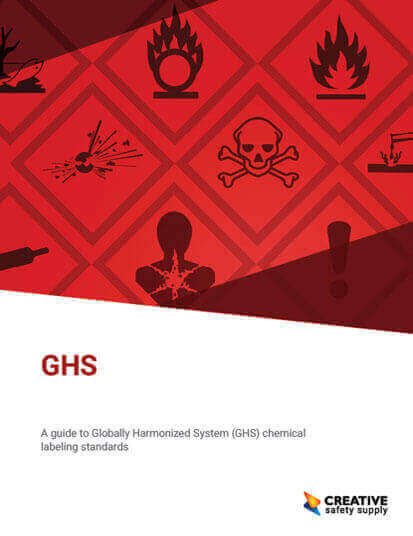
The Globally Harmonized System of Classification and Labeling of Chemicals (GHS) consists of two sets of hazard pictograms: one used for labeling containers and the other for transportation of dangerous goods.
There are 9 diamond-shaped pictograms with red borders and a black symbol on a white background. Each symbol depicts a type of hazard: physical, health, or environmental, making it crucial for workers to pay attention to detail during GHS label creation.
NFPA 704: Fire Hazard Pictogram for Appropriate Emergency Response
The NFPA 704 is a multicolored fire diamond that rates the severity of flammability, health, and instability of hazards. Divided into four quadrants, the bottom white one is reserved for special hazards that warn firefighters or emergency responders of the unique risks of a substance or mixture. It contains black symbols
Annotated by numbers and symbols, the fire diamond is considered a type of hazard sign symbol, or in a broader context, a pictogram. Commonly used in workplaces that handle or store chemical substances.
Traffic Hazard Pictograms to Warn Drivers
The Department of Transportation authorizes standardized road safety signs, specific color codes, and black symbols to warn drivers about upcoming road conditions, dangers, sudden road changes, such as speed bumps or U-turns. Common examples of traffic hazard pictograms are triangle-shaped signs marked by a black graphic symbol.
Some examples of traffic hazard symbols are:
- Slippery when wet: Indicates a tilted car with squiggly lines, warning of low traction from rain/snow.
- Animal Crossing: Features a black silhouette of a deer, bear, or moose.
- Sharp Curve/Turn: An arrow bending to indicate a sharp change in direction.
- No Bicycles: Consists of a bicycle symbol with a strike through, indicating no bicycles on this path.
These symbols can be painted on a red or yellow background, and appear in advance of hazards to allow safe speed adjustment.
Ionizing Radiation Hazard Pictogram To Alert Workers
Radioactive materials pose significant health risks, mandating the application of safety signs to alert workers who handle, use, or store dangerous radioactive substances. Initially, a trefoil symbol in magenta color with a blue background was designed by a mechanical engineer (Cyrill Orly) and was adopted as a standard by ANSI in 1969.
Later in 2007, the International Atomic Energy Agency (IAEA) and the International Organization for Standardization (ISO) proposed a new sign that will replace the traditional trefoil symbol. It highlights the original trefoil symbol emitting waves, with a skull-and-crossbones symbol and a running figurine on a red triangle with black borders.
This hazard pictogram is specifically designed for sources that house radiation materials or substances and should be abandoned immediately. Commonly found in X-ray rooms, radioactive material storage houses, nuclear facilities, and transport containers to prevent accidental exposure.
Pesticide Hazard Pictograms for Safe Use, Handling & Transportation
Pesticides are substances designed to eliminate and control pests, but most can also be harmful to humans. Exposure to pesticides can lead to acute poisoning (nausea, dizziness, respiratory issues) and chronic illnesses like cancer, neurological disorders, and endocrine disruption.
The United States Environmental Protection Agency (EPA) uses two GHS pictograms:
- A version of skull and crossbones for acute toxicity
- Flame symbol for highly flammable pesticides
While it’s not completely mandatory for supplies involved in the consumption and import of pesticides to abide by GHS labeling requirements. Some individuals may comply with GHS labeling requirements for their leniency during international trade.
Biohazard Pictogram For Materials That Cause Health Risks
The biohazard pictogram is a universally recognized symbol that is used to identify hazardous materials that pose a significant risk to human health, such as viruses, toxins, and contaminated waste. The biohazard symbol is a trefoil positioned within a circle, proposed by Charles Baldwin in 1966.
Ensuring Safety With Hazard Pictograms
Pictograms play a critical role in hazard communication, providing workers with visual insight to make quick decisions to prevent or minimize hazards. A good starting point would be to learn more about the relationship between hazard pictograms and safety signs to ensure effective hazard communication.
Similar Articles
- Understanding Canadian Pipe Marking Standards (CAN/CGSB-24.3-12) and Hazard Symbols
- GHS Label Creation
- GHS Label Information
- The Definitive Guide to Globally Harmonized System (GHS) Labeling
- Job Hazard Analysis: Addressing Coronavirus Risk in Your Workplace
- Hierarchy of Controls [Hazard Exposure + Prevention]
- What is HAZCOM? (Hazard Communication Definition + OSHA Standards)
- Handling Hazardous Materials Safely
- Hazard and Operability (HAZOP Analysis)
- Addressing Biohazard Safety in the Workplace