
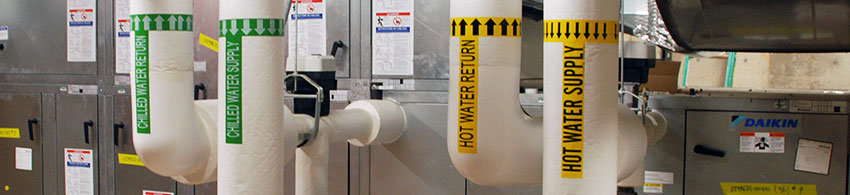
Water pipes should be labeled according to the ANSI/ASME A13.1 pipe marking standard, which identifies pipe contents using specific color combinations, text, and directional arrows. The goal is to clearly communicate what type of water the pipe carries and any associated hazards, so workers can perform maintenance and respond to emergencies safely and efficiently.
Under the 2023 ANSI/ASME A13.1 standard, water pipes are labeled using three distinct color designations, depending on the system’s function and temperature:
- Red background with white lettering – Used for fire‑quenching systems, such as fire sprinkler lines, standpipes, and other fire protection water systems.
- Green background with white lettering – Used for cold or tepid water, including potable water, domestic water, and general process water.
- Gray background with black lettering – Used for hot water, steam, or condensate systems.
Each pipe marker should clearly state the contents of the pipe (for example, Potable Water, Hot Water Return, or Fire Sprinkler Supply) and include flow direction arrows to show the direction of travel.
Labeling water pipes is just as important as labeling pipes that carry hazardous chemicals. Water systems often play a critical role in facility operations and almost always require maintenance at some point. Without clear identification, workers may be forced to rely on old drawings or guesswork—both of which increase the risk of accidents.
Working with water piping can still be dangerous if it is mislabeled or unlabeled. The water inside a pipe may be extremely hot, under pressure, or contaminated. Fire‑quenching systems present additional risks if they are accidentally shut off or activated.
Proper pipe labeling helps prevent hazards such as:
- Burns from hot water, steam, or condensate
- Slips and falls caused by leaks or ruptures
- Illness or exposure from contaminated or non‑potable water
- Fire protection failures due to misidentified systems
In short, water pipes are labeled by applying ANSI/ASME A13.1‑compliant pipe markers that use the correct color scheme, clear text, and flow direction arrows. Following these standards helps keep facilities organized, supports safer maintenance practices, and reduces the likelihood of preventable accidents.
Similar Questions
- How do you label pipes?
- What color are steam pipes?
- what does a yellow pipe label mean?
- What is a FIT Test (for Respirators)?
- What is pipe labeling/pipe marking?
- Why is pipe labeling important?
- What information can I include on a pipe label?
- Does OSHA require pipe labeling?
- What are ANSI’s Pipe Labeling Standards?

