
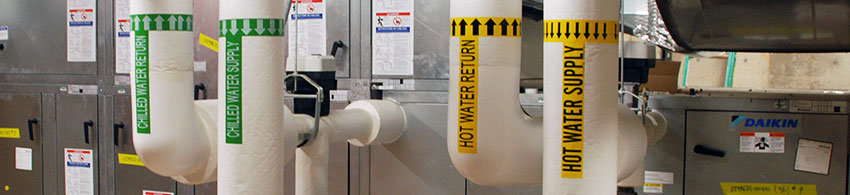
A blue label on a pipe often indicates that the pipeline contains compressed air. This is the standard for general industries in the United States, which follow the ANSI/ASME A13.1 color schemes for pipe content identification. However, for other facilities, regions, and applications using different pipe marking standards, a blue pipe label can mean different things. That is why it’s important to check other information on the pipe label, such as text or the facility's specific safety color chart and diagrams for exact identification.
Let’s look at some examples where a blue pipe label doesn't necessarily mean compressed air pipelines.
Different Examples of a Blue Pipe Label
Since there are various pipe marking standards and color codes, a blue label can denote different substances in different locations and facilities:
Compressed Air: (most common, especially in the US). The ANSI/ASME A13.1 color schemes for pipe content identification designates pipes containing compressed air should utilize a blue pipe label.
Potable Water: In the field of underground utility locating, blue markings on the ground are the universal indicator for potable water lines, as defined by the APWA Uniform Color Code.
Fresh Water Systems: In marine facilities, following the ISO 14726 standard, blue is the primary color used for fresh water systems, including drinking water and general washdown water.
Nitrous Oxide: In healthcare environments in the US, a blue background on a pipe label with white text specifically indicates Nitrous Oxide, as mandated by the NFPA 99. Similarly, the standard ISO 7396-1 for medical gas pipeline systems also generally designates blue for nitrous oxide.
Air: The comprehensive international standard for pipe marking, ISO 20560, uses blue as the basic identification color for air within the main color zone of the marker.
- Fresh Water: In the United Kingdom, the BS 1710 standard uses an auxiliary blue as a basic identification color specifically for fresh water lines.
In such scenarios, the important identifier is the accompanying text on the pipe label, which explicitly names the contents, such as "Compressed Air", "Potable Water", "Chilled Water", etc.
Similar Questions
- Does OSHA require pipe labeling?
- what does a yellow pipe label mean?
- How do you label water pipes?
- What are the different standards of pipe marking?
- What information can I include on a pipe label?
- What color are steam pipes?
- What are ANSI’s Pipe Labeling Standards?
- What is a pipe marker?
- Does OSHA regulate pipe marking?

