
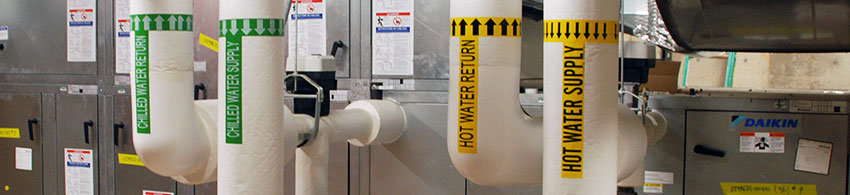
Pipe labels help workers quickly identify the contents of a pipe and associated hazards, enabling safe handling and fast, informed decisions during routine maintenance, troubleshooting, and emergencies. That is why your pipe marker should include all the information necessary to help personnel safely identify and handle the substance in the pipe. Let’s explore what key information must be present on pipe labels.
Requirements of a Pipe Marking Label
Below are the core elements that should appear on a pipe label.
- Name of Contents: Clearly identify what substance the pipe carries, like potable water, gas, etc. Make sure to use simple, standardized names so there is no ambiguity.
- Color Coding: Use standardized colors like ANSI/ASME color codes or facility-specific codes. Color quickly differentiates pipe groups, such as water, gases, fire protection, or hazardous materials.
- Flow Direction: Use arrows to show the direction the contents move through the pipe. These are critical during maintenance, system shutdowns, and emergency response.
- Hazard Information (When Applicable): Indicate physical or chemical hazards, such as flammable, corrosive, toxic, high-pressure, high-temperature, etc. This will help workers understand precautions at a glance.
- Safety Symbols or Pictograms: Add relevant hazard pictograms or safety symbols for quick visual communication. These details on your pipe markers are useful in cases where multiple languages are spoken or in low-visibility areas.
- Label and Font Size: Choose a label size and text height that can be read from a safe distance. For larger pipes or higher mounting locations, you will need larger markers to ensure legibility under real-world conditions.
So at minimum, most of your facility’s pipe labels must have the contents name, color coding, and flow direction. If hazards are present, hazard text or symbols must also be included.
Some pipelines may also require you to add additional details on the label, such as temperature or pressure notes, system line numbers, contact information, or emergency instructions. These are not always required by standards, but can support internal safety programs. In such situations, you can choose to create custom pipe labels in-house with an industrial label printer and durable supplies to meet your facility’s unique labeling needs, or order custom pipe labels from a supplier like Creative Safety Supply.
Improving Your Facility’s Pipe Identification
The above essential label elements ensure that pipe markers communicate the right information quickly and clearly. While your facility’s pipe-marking program may involve additional standards or placement rules, the details above focus specifically on what belongs on the pipe label itself and how they should be placed, helping users understand the contents of any marked pipe at a glance.

