
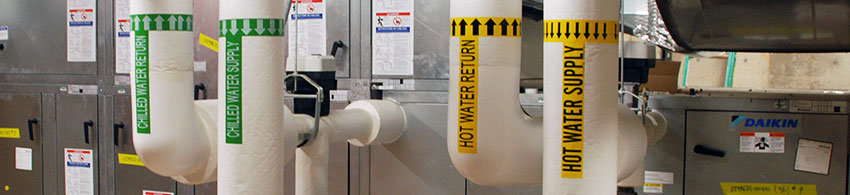
ISO 20560-1 provides a globally harmonized system for marking overground pipes, replacing various national standards with a single international framework. By standardizing the identification of contents and hazards, it reduces risks, improves maintenance efficiency, and ensures faster emergency response across multinational facilities.
Let’s dive deeper and explore the core requirements of ISO 20560-1 for marking overground piping systems and understand its global status and local implementation.
Key Components Of ISO 20560 Pipe Marking Standard
The ISO 20560-1 standard relies on a mandatory and integrated system of visual components working together to achieve international harmonization and clarity.
Colour Coding to Identify the Nature of the Pipe Content
One of the most visible elements of the ISO 20560-1 standard is the use of two color zones: basic identification colors for content types and a safety color (yellow) for hazardous substances. The basic identification colors include:
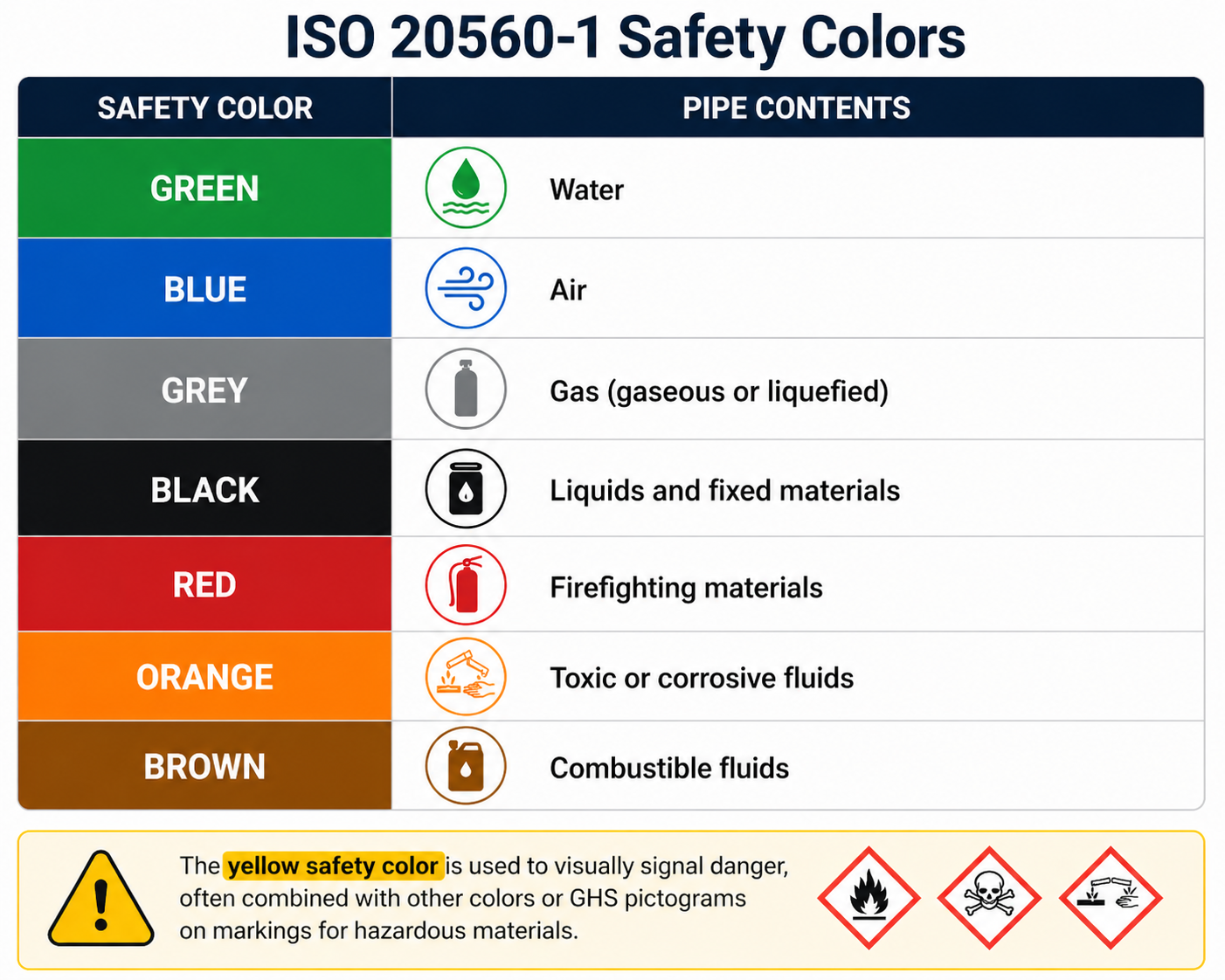
By standardizing pipe marking colors, the ISO 20560-1 helps a person see a pipe label and immediately understand the nature of the fluid and hazard.
Contents Name
In addition to the colour coding, the 20560-1 standard requires the actual “name” or description of the pipe contents to appear on the pipe marking. This helps avoid ambiguity by specifying the exact substance. For example, a gray background might mean "gas," but the name clarifies if it's "Compressed Air," "Natural Gas," or any other gas. Knowing the precise content ensures the correct safety procedures are followed and prevents potential accidents when handling hazardous materials.
Flow Direction Indicators
The 20560 pipe marking standard mandates a clear indication of the flow direction of the medium within the pipe. This is typically done via arrows that quickly indicate the direction of flow for maintenance, emergency response, and correct operation. The placement of the arrow is a crucial design detail; for instance, in vertical pipes, the text reading direction typically flows from bottom to top for upward flow, and the arrow should align with that direction.
Warning Signs and GHS Pictograms
Where pipelines contain hazardous substances, the ISO 20560 standard requires the inclusion of appropriate warning signs or GHS pictograms. For example, if the substance is corrosive or toxic, the pipe marker may include the relevant GHS symbol next to the text and colour-coded band. This helps ensure that even someone unfamiliar with the facility can recognise key hazards.
Additional Requirements of the ISO 20560 Pipe Marking Standard
The ISO 20560 pipe marking standard also specifies requirements for placement, sizing, and technical durability, ensuring labels are consistently visible and understood across different environments and languages. Let’s look at these requirements in detail.
Additional Safety Requirements
According to ISO 20560-1, if additional safety information, such as high pressure or flow quantity, is needed on a pipe label, it should be placed on a colored background next to the content name, using the same contrast color as the content name.
Additional Technical Requirements
As specified in ISO 20560-1, any additional technical information, such as a brief description of a function or service, should be presented in a contrasting black color on a white background. This deliberate color contrast ensures that the technical details are easily distinguishable and that the unambiguous safety identification system remains the immediate focus for anyone viewing the pipe marking.
Sizing and Placement
The ISO 20560-1 standard requires pipe markings to be sized based on pipe diameter for legibility and placed at intervals and strategic locations to ensure visibility from a safe distance. This includes marking at intervals on straight runs, both sides of penetrations, and near valves and flanges. The sizing depends on factors like viewing distance and pipe diameter.
Moreover, the materials for pipe labels should resist fading, wear, and environmental damage, while text and symbols remain legible from normal viewing distances. These pipe marking guidelines ensure consistent, long-lasting safety communication across different facilities and languages.
ISO 20560-1’s Global Influence vs. Local Implementation
The ISO 20560-1 standard has global influence as a unified standard for safety information on piping systems, but its implementation remains subject to local and national statutory regulations, which can vary. While the standard seeks to establish a consistent global approach, it does not automatically supersede existing local laws.
The Impact of Standardized Pipe Marking Through ISO 20560-1
The ISO 20560-1 is essential for standardizing pipe marking practices in the global industrial landscape. Adopting ISO 20560-1 improves workplace safety, minimizes downtime, and ensures compliance with international best practices, simplifying training for organizations worldwide. Ultimately, it serves as a global safety language, promoting clearer communication and a safer industrial environment.
Similar Questions
- What are the different standards of pipe marking?
- What are ANSI’s Pipe Labeling Standards?
- What are pipe labeling standards for sea vessels and marine environments?
- What is pipe labeling/pipe marking?
- What are some examples Of Best Safety Practices For Ammonia Pipe Marking
- What do user-defined color combos mean for pipe marking?
- What Are the ISO Standards for Food Safety?
- What colors should ammonia pipe labels be?
- What text should I use on a pipe label?

