
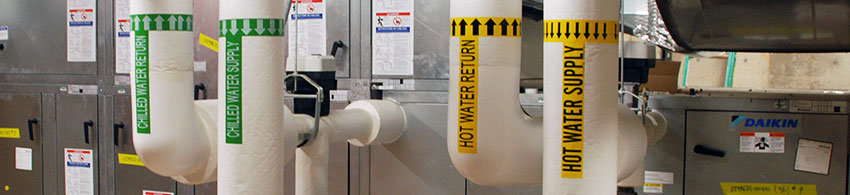
Pipe marking is an essential part of workplace safety, providing quick, visual identification of pipe contents and their associated hazards. ANSI/ASME A13.1 establishes standard color codes for common substances; however, many facilities handle materials or processes that go beyond these standard classifications. In such situations, facilities turn to user-defined color codes.
User-defined color codes, as recognized by ANSI/ASME A13.1, are specific color combinations reserved for marking pipes and equipment when the standard color options are not sufficient. This flexibility allows facilities to clearly identify non-standard substances and maintain consistency across locations while ensuring compliance. Understanding these color codes is essential to ensure safety and compliance when a facility needs to label contents that don't fit standard categories.
Standard vs User-Defined Color Codes
The ANSI/ASME A13.1 standard defines specific colors for common types of substances and fluids to help personnel quickly identify pipe contents and ensure uniformity across facilities. User-defined color codes, on the other hand, are custom combinations reserved by ANSI/ASME A13.1 for situations not covered by the standard colors. They allow facilities to:
- Identify non-standard materials or specialized fluids
- Provide further classification within an existing category (e.g., potable vs. cooling water)
- Maintain consistency across multiple facilities
Clear documentation and training are essential to ensure personnel understand user-defined codes.
Examples of User-Defined Color Codes
The ANSI/ASME reserves four specific color combinations that are as follows:
- Purple with White Text: Specific hazards or utilities not covered by standard colors
- Black with White Text: Custom product categories
- White with Black Text: Custom labels requiring high contrast
- Brown with White Text: Specific pipelines not covered by predefined colors
These color combinations provide help in implementing more granular and custom pipe labeling while still adhering to a recognized standard. Let’s look at the uses of these color combinations:
- A facility may label drinking water with black text on white, while using green for other water types.
- A pharmaceutical plant might use white text on black for ultra-pure water to separate it from regular water.
- A chemical terminal could label recycled process water with black text on white to differentiate it from standard green potable water.
- An electronics manufacturing facility may use black text on white for ultra-clean deionized water lines, clearly marking them from other types.
Key Considerations for Effective Implementation
For pipe labels with user-defined color combinations to be effective and safe, the following must be in place:
- Consistency: Apply codes uniformly across the facility and locations
- Documentation: Clearly record meanings in safety plans
- Training: Educate all staff and emergency personnel
- Legend and Content: Labels should include critical information such as the pipe contents, flow direction, and hazard warnings.
- Size and Placement: Ensure labels are visible and readable from a safe distance
- Compliance and Review: Align with applicable industry standards and regulations and conduct periodic audits
User-defined color codes provide additional color combination options to meet specific facility needs and identify substances not covered by the six standard pipe color codes defined in ANSI/ASME A13.1. When applied consistently, documented, and supported with training, these custom labels improve operational efficiency, reduce errors, and strengthen workplace safety.
Similar Questions
- Can I create custom pipe labels and still be compliant?
- What are the ANSI standards for pipe color codes?
- What are the valve color codes?
- What are the different standards of pipe marking?
- What is the ASME standard for pipe marking?
- What should the height of text on a pipe label be?
- What is pipe labeling/pipe marking?
- What are pipe labeling standards for sea vessels and marine environments?
- What Information Can I Include on a Pipe Label?

