
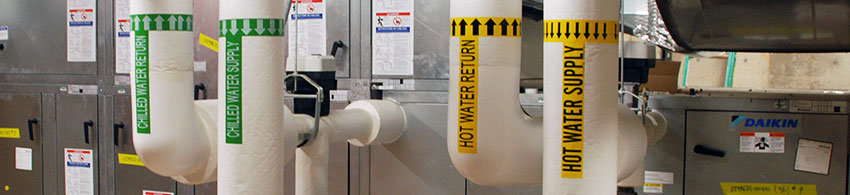
The American National Standards Institute (ANSI) is a non-profit organization that establishes and publishes standards for various industries and applications. One of the areas where ANSI has developed standards is pipe labeling. ANSI's pipe labeling standards provide a consistent and standardized system for identifying pipes, valves, and other equipment throughout a facility. This helps to reduce confusion and improve safety by making it easy for workers to quickly identify the contents of a pipe and take the necessary precautions.
The most widely recognized ANSI standard for pipe labeling is ANSI A13.1. This standard provides guidelines for the identification of pipes based on their contents, including the use of specific colors, wording, and lettering.
The ANSI A13.1 standard specifies the use of specific colors to identify the contents of a pipe. These colors include red for fire protection, black and white for instrument air, blue for compressed air, green for safety showers and eyewashes, and yellow for gas, oil, steam, and other gaseous materials. The standard also specifies the use of specific wording and lettering to identify the contents of a pipe. For example, pipes carrying steam should be marked with the word "STEAM" in black letters on a safety yellow background.
The standard also provides guidelines for the size, spacing, and placement of pipe labels. For example, it specifies that labels should be located in a way that makes them visible from the direction of normal flow, and that they should be placed at least 6 inches above the floor or ground.
Similar Questions
- What are the ANSI standards for pipe color codes?
- What are the different standards of pipe marking?
- What are pipe labeling standards for sea vessels and marine environments?
- What color code is used for a piping system conveying gaseous elements?
- What information can I include on a pipe label?
- what does a yellow pipe label mean?
- What is pipe labeling/pipe marking?
- Does OSHA require pipe labeling?
- Is pipe labeling required by law?

