
Plan-Do-Check-Act (PDCA Cycle)
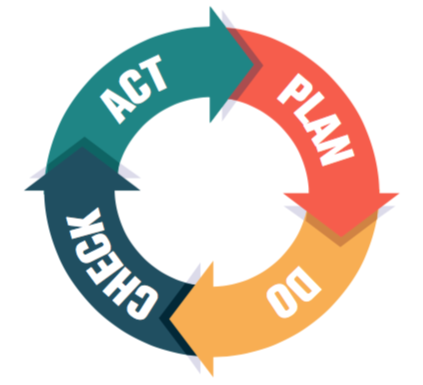
The Plan-Do-Check-Act (PDCA) cycle, also known as the Deming cycle or Shewhart cycle, is a four-step iterative process for continuous improvement in problem-solving and process management. It involves planning, doing, checking, and acting, and is fundamental to lean manufacturing and Kaizen. The four stages of the PDCA cycle are:
 Plan: Assess the current state and look for improvements. If a problem exists, examine it in detail. Develop possible solutions and means of execution. In this phase, gather as much information as possible to make informed decisions about how to proceed.
 Plan: Assess the current state and look for improvements. If a problem exists, examine it in detail. Develop possible solutions and means of execution. In this phase, gather as much information as possible to make informed decisions about how to proceed.
- Do: Try out the plans, making sure everyone involved understands the changes. This implementation phase is key to getting accurate results.
- Check: Follow up to see how effective the changes are. Spend some time comparing the new state to how things were previously
- Act: If the changes work, continue using them and make them the new standard. This will be the new point of reference for future PDCA efforts.
The PDCA cycle is not a one-time event, but rather a continuous loop, with the "Act" phase leading back to a new "Plan" phase to further refine and improve the process.
Origins of the PDCA Cycle
The PDCA cycle originated in the 1920s through the work of Walter Shewhart, a physicist, engineer, and statistician. It gained further development and popularity in the 1950s thanks to W. Edwards Deming, an American engineer, statistician, and management consultant. Consequently, the PDCA cycle is commonly known as either the Deming cycle or the Shewhart cycle.
Deming introduced the PDCA cycle to Japan in the 1950s, where it was widely embraced and became known as the "Deming Cycle." In 1985, Kaoru Ishikawa, a prominent figure in the Japanese quality movement, refined the PDCA cycle even further. He provided additional details for the "Plan" and "Do" steps, emphasizing the importance of setting clear goals and targets, as well as the necessity of education and training for effective implementation.
The Plan-Do-Check-Act Cycle and Lean Manufacturing
The PDCA cycle has become an important part of Lean manufacturing in many businesses. Like value stream mapping, OEE, and Takt time, PDCA can help identify waste for elimination and contribute to kaizen efforts. It's often used when a problem has been identified and people need to figure out how to fix it. The PDCA is a great step to take after a business has just evaluated their facility’s Takt time and discovered production to be out of sync. Another great time for PDCA is after they've calculated Overall Equipment Effectiveness (OEE) and found suboptimal results.
PDCA can be used at any time, though, regardless of whether a problem has presented itself. To start using PDCA, people involved should spend some time observing the current situation to determine what’s wrong or what could be done better. Having enough information makes a big difference in whether PDCA will yield successful results.
The PDCA cycle is a helpful way to think about improving any process in the workplace, so it’s beneficial to teach employees how to do it and have them participate in the process. PDCA is usually a team effort, but the thinking behind it can be used by individuals to improve their tasks, too.